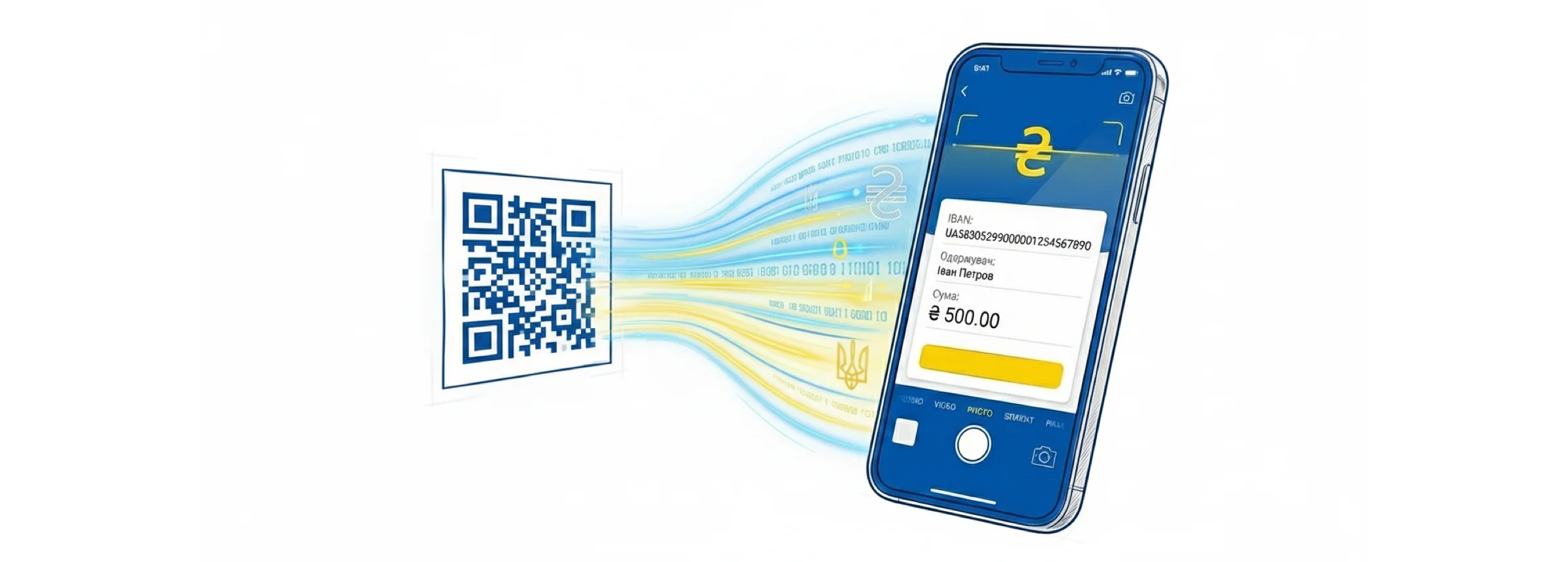
QR Transfers Without Manual Entry: A Revolution in Payment Convenience
In Ukraine's rapidly evolving digital payment landscape, QR code transfers represent a fundamental shift in how people make payments. Instead of manually entering lengthy IBAN numbers, recipient names, tax identification codes, and payment purposes, payers can now complete transactions by simply scanning a code. This transformation eliminates human error, accelerates payment processing, and makes cashless transfers accessible to everyone with a smartphone and banking app.
How QR Payments Work: The Payer's Perspective
When you encounter a QR code for payment—whether on a café counter, in a utility bill, or in an online invoice—the process is remarkably straightforward. Open your banking app, tap the QR scanner (typically prominently displayed on the home screen), and point your camera at the code. Within seconds, your banking app automatically populates all payment fields with pre-encoded information: the recipient's IBAN, their full name, tax identification number, payment amount, currency, and transaction purpose.
This automatic data transfer happens according to standardized rules established by the National Bank of Ukraine in 2020. The QR code contains structured information formatted to work seamlessly with all compliant banking applications across Ukraine's financial system. You simply verify the pre-filled details, select which card or account to use for payment, and confirm the transaction.
The entire process typically takes less than 15 seconds from scanning to completion. Compare this to traditional manual entry, where typing a 29-character IBAN alone could take 30-40 seconds, with additional time needed for entering recipient details and payment purposes. More importantly, manual entry carries significant risk of typographical errors—a single mistyped digit in an IBAN can send funds to the wrong account or cause transaction failures.
Eliminating Payment Errors: The Primary Advantage
Human error in payment data entry represents one of the most common frustrations in digital banking. Transposing two digits in an IBAN, misspelling a recipient's name, entering an incorrect tax ID, or omitting crucial payment purpose information can result in delayed transfers, failed transactions, or funds sent to wrong accounts. Recovery from such errors often requires contacting customer support, filling out dispute forms, and waiting days or weeks for resolution.
QR code payments eliminate this entire category of problems. The payment information is encoded directly by the recipient or their service provider, ensuring accuracy from the source. When you scan the code, you're transferring data digitally rather than transcribing it manually. The National Bank of Ukraine specifically highlighted this benefit when introducing QR payment standards, noting that error elimination is one of the technology's most valuable features for consumers.
This reliability is particularly important for payments that require precise formatting or specific reference numbers. Utility payments, for example, often require exact account numbers and payment codes. Government fees and taxes demand correctly formatted tax identification numbers and payment purposes. Business-to-business transactions may need detailed invoice references. QR codes ensure all this information transfers perfectly every time.
Speed: From Minutes to Seconds
Modern banking in Ukraine operates on two distinct payment rails that affect transaction speed. Traditional credit transfers between different banks typically process within an hour during business hours, with potential delays outside banking hours or on weekends. However, Ukraine's upgraded Electronic Payment System (SEP-4.1), launched in December 2024, introduced instant payment functionality that fundamentally changes this timeline.
When you make a QR payment through a banking app that supports instant payments, the transaction completes within 10 seconds. This isn't marketing hyperbole—it's the technical standard established by the National Bank of Ukraine for instant credit transfers. The upgraded SEP-4.1 system, built on international ISO 20022 standards, processes transfers in real-time 24 hours a day, 7 days a week, including weekends and holidays.
For payers, this speed translates to immediate transaction certainty. When purchasing goods or services, you receive instant confirmation that payment has been completed. The merchant simultaneously receives notification of funds arrival. This real-time settlement eliminates the awkward waiting periods that characterized earlier digital payment methods, where you might wonder for hours whether your payment went through successfully.
The instant payment functionality supports transactions up to 100,000 UAH per transfer—sufficient for the vast majority of retail and small business transactions. For larger amounts or specific transaction types (such as payments involving non-residents), the system automatically processes transfers through traditional channels, typically completing within one hour.
Universal Banking App Support
One of QR payment technology's most significant advantages is its cross-bank compatibility. You don't need to use the same bank as the payment recipient, and you don't need any special payment apps beyond your regular banking application. Ukraine's major financial institutions have integrated QR scanning functionality into their mobile banking apps, making the technology accessible to millions of users.
PrivatBank's Privat24 app, which serves over 20 million users, prominently features QR scanning on its main screen. Monobank's application, popular among younger demographics and tech-savvy users, includes comprehensive QR payment functionality alongside its other digital features. OTP Bank integrated QR scanning with its instant payment rollout, allowing customers to combine the convenience of QR codes with 10-second settlement times. Sense Bank, PUMB, UkrGasBank, Accord Bank, and dozens of other Ukrainian financial institutions have similarly equipped their apps with QR payment capabilities.
This widespread adoption means you can use QR payments regardless of which bank holds your account. A customer with a PrivatBank card can scan a QR code to pay a business that banks with OTP Bank. Someone using Monobank can settle a utility bill issued by a company with a PUMB account. The standardized QR format ensures interoperability across the entire Ukrainian banking system.
Most banking apps require no special setup to use QR payments. The scanning functionality is built into the standard app interface, typically accessible with a single tap from the home screen. Some banks have further simplified the process by allowing users to create payment shortcuts or save frequently used QR codes for even faster repeat transactions.
Real-World Use Cases
QR payment technology serves diverse payment scenarios, each benefiting from the error reduction and speed advantages the technology provides.
Retail and Service Payments: Walk into a café, restaurant, or retail store where the business displays a QR code at the counter or on a table tent. Scan the code, verify the amount, and complete payment within seconds. This approach is particularly popular in businesses that want to accept cashless payments without investing in traditional payment terminals or paying merchant service fees associated with card acquiring.
Utility and Service Bills: Many Ukrainian utility providers and service companies now include QR codes on their billing statements. Instead of manually entering lengthy account numbers and payment codes, you simply scan the code from your paper or electronic bill. The system automatically populates your account number, correct payment amount (including any outstanding balance), and all necessary reference information. This is particularly useful for utility payments where incorrect account numbers or payment purposes can result in misapplied payments and service disruptions.
Government Fees and Taxes: Various government agencies and administrative services have adopted QR codes for fee collection. Whether paying for administrative services, fines, or taxes, the QR code ensures all required information—including specific payment codes and tax identification numbers—transfers correctly to prevent processing delays.
Online Purchases and Invoices: E-commerce sites and online service providers can include QR codes in digital invoices and payment pages. This is particularly convenient for mobile users, who can scan the code directly from a computer screen when shopping on a laptop or desktop, then complete payment on their smartphone. Alternatively, some systems allow users to scan codes directly within their mobile browser, which then opens the banking app with pre-filled payment information.
Person-to-Person Transfers: While not strictly a business use case, individuals can generate QR codes for personal money requests. This is useful for splitting bills, collecting contributions for group gifts, or any situation where one person needs to receive specific payments from multiple people. The QR code eliminates the need to share IBAN details via text or email and ensures everyone sends funds to the correct account.
Technical Foundation: Standards and Infrastructure
Ukraine's QR payment ecosystem operates on technical foundations designed for reliability, security, and international compatibility. The National Bank of Ukraine established unified rules for QR code generation and usage in its 2020 resolution "Rules for the Formation and Use of QR Codes for Credit Transfers." These rules define standard data elements that must be included in payment QR codes and specify how banking applications should process scanned information.
The underlying payment infrastructure follows the international ISO 20022 standard—the same messaging standard used by payment systems across Europe and globally. This alignment ensures Ukrainian QR payments use globally recognized data structures and messaging formats, facilitating future integration with European payment systems and international payment networks.
The Electronic Payment System (SEP-4.1), which processes QR code transfers, operates 24 hours a day, 7 days a week, including all weekends and holidays. This continuous operation, combined with instant payment functionality introduced in December 2024, means QR payments process at any time without the banking hour restrictions that once limited electronic transfers.
From a payer's perspective, this infrastructure means several things: your payments process reliably according to established standards, different banks' systems communicate seamlessly, and the technology is built on proven international frameworks rather than proprietary systems that might create compatibility issues.
Security and Compliance
QR code payments incorporate multiple security layers that protect both payers and recipients. When you scan a QR code, the information transfer happens locally on your device—the code itself doesn't transmit data over networks or to external servers. Your banking app decodes the information and displays it for your verification before you authorize any transaction.
This verification step is crucial: always review the pre-filled payment details before confirming a transaction. While QR codes eliminate manual entry errors, you should still confirm the recipient name, amount, and payment purpose match your expectations. This simple verification protects against scenarios where someone might display an incorrect or fraudulent QR code.
Banking apps implement the same authentication and security measures for QR payments as for any other transaction. You must authenticate with your usual security method—whether PIN, biometric (fingerprint or face recognition), or other authentication factors your bank requires. The QR code simply provides payment data; it doesn't bypass your bank's security protocols.
Ukraine's QR payment standards comply with the Law of Ukraine "On Payment Services" and align with international payment security standards. The National Bank of Ukraine regulates payment service providers and ensures they maintain appropriate security measures for all payment types, including QR-initiated transfers.
From a practical security standpoint, QR payments are typically safer than many alternatives. You're not entering card details into potentially insecure websites or payment terminals. You're not exposing your card number to merchant systems that might be compromised. You're simply authorizing a direct bank transfer after reviewing the details on your own device, protected by your banking app's security infrastructure.
Beyond Static QR Codes: Payment Links and Dynamic Codes
While printed QR codes serve many payment scenarios, the underlying technology supports additional implementation methods that further enhance convenience.
Payment Links (Deeplinks): Instead of a visual QR code, recipients can send payment information as a clickable link via SMS, email, messaging apps, or social media. When you click the link on a smartphone with a compatible banking app installed, the app automatically opens with pre-filled payment details. This approach is particularly useful for remote payments, online invoicing, or any scenario where sharing a visual QR code isn't practical.
Dynamic QR Codes with Pre-Set Amounts: Some implementations allow QR codes to include specific payment amounts, automatically populating not just recipient details but the exact sum due. This is common in retail settings, restaurant bills, and utility payments where the amount owed is predetermined. You simply verify the amount is correct and approve the payment.
Multi-Purpose QR Codes: More sophisticated implementations can present different payment options based on context. For example, a utility company might use a single QR code that, when scanned, retrieves your current account balance and outstanding charges, then pre-fills the payment form with the exact amount due. This combines the convenience of QR scanning with real-time account information.
These variations all follow the same fundamental principle: they eliminate manual data entry by transferring structured payment information directly to your banking app, where you verify and authorize the transaction.
The Broader Context: Ukraine's Digital Payment Evolution
QR payment adoption is part of Ukraine's larger transition toward modern, digital financial infrastructure. The country has experienced remarkable growth in cashless payments over the past decade, driven by improved banking technology, increased smartphone adoption, and changing consumer preferences accelerated by recent years' challenges.
The integration of instant payment functionality with QR code technology represents the convergence of two major payment innovations. Instant payments provide speed and real-time settlement. QR codes provide convenience and error elimination. Together, they create a payment experience that rivals or exceeds more expensive card-based payment systems, while operating on direct bank transfer rails that typically cost less for all parties involved.
This evolution aligns Ukraine's payment infrastructure with European standards and practices. The SEPA (Single Euro Payments Area) zone has embraced instant payments across its member states, and QR code payment systems are growing in European countries including Germany, France, and the Netherlands. Ukraine's adoption of ISO 20022 standards and instant payment functionality positions the country's payment infrastructure for eventual integration with European payment systems.
For individual payers, this broader context means the payment methods you learn and use today are built on sustainable, internationally recognized standards rather than temporary solutions or proprietary systems. The skills and habits you develop using QR payments in Ukraine will translate to similar payment systems across Europe and globally.
Practical Considerations and Limitations
While QR payments offer significant advantages, understanding their appropriate use cases helps set proper expectations.
Internet Connectivity Required: QR payments require your smartphone to have internet connectivity when you scan and authorize the payment. Your banking app needs to communicate with your bank's servers to process the transaction. Offline QR code scanning isn't possible with current implementations.
Banking App Required: You need a banking app installed and configured on your smartphone to use QR payments. While this is increasingly common—most Ukrainian bank customers have mobile banking apps—it represents a requirement that older non-smartphone users or those who prefer traditional banking methods may find challenging.
Transaction Limits: Instant payments through SEP-4.1 support transfers up to 100,000 UAH per transaction. Amounts exceeding this threshold process through traditional payment channels, which may take longer (typically up to one hour during business hours). While this limit covers most retail and small business transactions, very large purchases or payments may require alternative methods.
Same-Currency Transfers: QR code payments in Ukraine's current implementation work for UAH (Ukrainian hryvnia) transfers. Foreign currency transfers or currency conversion typically require different payment methods.
Banking Hour Independence with Caveats: While SEP-4.1 processes payments 24/7, individual banks may have their own operational procedures that affect when certain payment types can be initiated or completed. Most major Ukrainian banks support round-the-clock payments, but confirming your specific bank's capabilities is advisable for time-sensitive transactions outside typical business hours.
Looking Forward: The Future of QR Payments
As Ukraine's digital payment infrastructure continues evolving, QR code technology is likely to expand into additional use cases and gain enhanced capabilities.
Wider merchant adoption seems certain as more businesses discover they can accept cashless payments without investing in expensive card terminals or paying merchant service fees. The cost differential between traditional card acquiring (with its percentage-based fees and equipment costs) and QR-based IBAN transfers (with minimal or no transaction fees) creates strong economic incentives for business adoption.
Enhanced integration between QR payments and other services may emerge. Imagine scanning a QR code that not only initiates payment but also generates a digital receipt, adds the transaction to your expense tracking app, or triggers loyalty program rewards. The structured data format underlying QR payments makes such integrations technically feasible.
Cross-border QR payments could develop as Ukraine's payment infrastructure integrates more closely with European systems. The shared use of ISO 20022 standards and similar instant payment technologies creates a technical foundation for QR codes that work across borders, potentially allowing Ukrainian users to make QR payments in European countries and vice versa.
Deeper personalization and smart payment routing might evolve, where QR codes contain multiple payment options or dynamically adjust based on the payer's circumstances. For example, a single QR code might offer both immediate payment and installment options, with the banking app presenting appropriate choices based on the amount and the payer's account settings.
Conclusion
QR code payments represent more than just a convenient payment method—they exemplify a fundamental improvement in how payment information transfers between parties. By eliminating manual data entry, they remove the single largest source of payment errors. By integrating with instant payment systems, they provide real-time transaction certainty that earlier digital payment methods couldn't match. By working across all Ukrainian banking apps through standardized protocols, they ensure universal accessibility without creating fragmented payment ecosystems.
For payers, the benefits are immediate and tangible: faster transactions, zero transcription errors, simplified payment processes, and the convenience of needing only a smartphone camera and banking app to complete secure financial transfers. These advantages apply whether you're buying coffee, paying utility bills, settling invoices, or transferring funds to another individual.
As Ukraine continues building modern digital payment infrastructure aligned with international standards, QR payments stand out as a technology that delivers real value today while positioning the country's financial system for seamless integration with global payment networks tomorrow. The simplicity of scanning a code to complete a payment belies the sophisticated technical standards and infrastructure that make it possible—infrastructure that places Ukraine among the countries leading the global transition toward instant, digital, interoperable payment systems.
The next time you encounter a QR code payment option, you're not just using a convenient alternative to manual data entry. You're participating in Ukraine's digital financial transformation and experiencing payment technology that represents the future direction of retail banking worldwide.